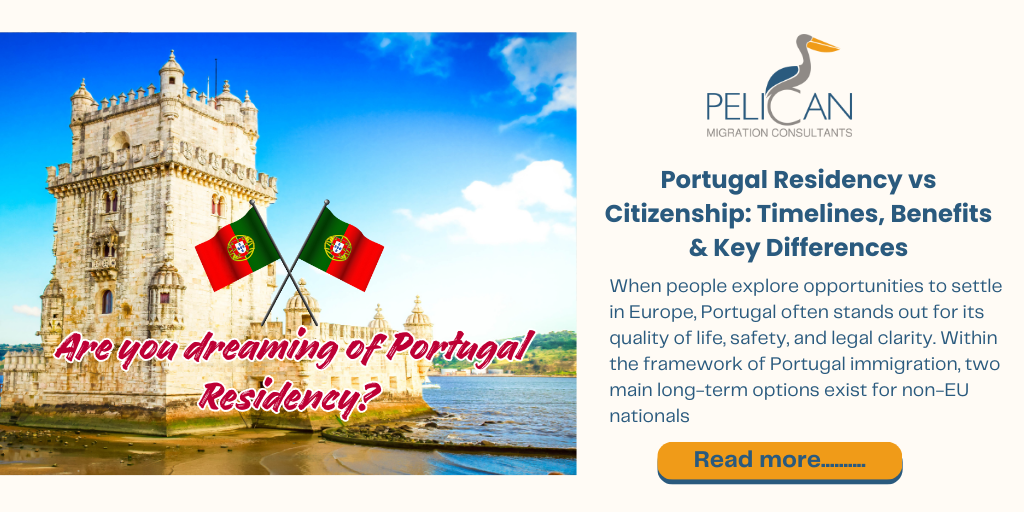
Portugal Residency vs Citizenship: Timelines, Benefits & Key Differences
When people explore opportunities to settle in Europe, Portugal often stands out for its quality of life, safety, and legal clarity. Within the framework of Portugal immigration, two main long-term options exist for non-EU nationals: residency and citizenship. While these terms are sometimes used interchangeably, they represent distinct legal statuses with varying rights, responsibilities, and timelines. Understanding these differences is essential for making informed decisions about your future in Portugal.
The Portugal Residency and Its Speciality
Portugal residency is the foundation for legally living in the country as a non-EU national. It usually begins with temporary residency, which allows individuals to reside in Portugal for a fixed period, provided they meet specific conditions, such as maintaining a stable income, securing suitable accommodation, and demonstrating lawful behavior.
Temporary residents are legally allowed to live in Portugal and gradually integrate into Portuguese society. This period is not only about physical presence but also about building a compliant and continuous legal record that can support long-term status upgrades.
Entry Pathway to Residency
Most applicants begin their journey through a Portugal visa, which serves as the legal entry route into the country. This visa is tied to specific eligibility criteria and allows individuals to enter Portugal with the intention of applying for residency once they arrive.
After successful entry, residents transition into temporary residence permits, which are typically valid for one to two years and are renewable. Each renewal reinforces legal continuity, which is critical for future eligibility for permanent status.
Permanent Residency: A Key Milestone
After completing five years of lawful and continuous residence, individuals may apply for permanent or long-term residency under Portugal immigration law. This status offers strong legal security, as it allows indefinite residence in Portugal with renewals required only once every ten years.
Permanent residents gain access to public healthcare, education, employment opportunities, and financial services. This level of stability makes permanent residency an attractive option for those who wish to settle in Portugal without immediately pursuing nationality.
Professional Guidance and Long-Term Planning
At this stage, many applicants seek advice from Immigration Consultants in Dubai, particularly those planning relocation from the Middle East. Expert guidance can help clarify eligibility, documentation requirements, and renewal timelines, ensuring that applicants remain compliant throughout the process.
Such professional input is especially useful for individuals managing international income, dependents, or long-term relocation strategies.
Limitations of Permanent Residency
Despite its advantages, permanent residency under portugal immigration does have limitations. Residents do not receive political rights such as voting in national elections, nor do they gain a Portuguese passport.
Additionally, while residents can travel within the Schengen Area for short stays, they do not enjoy unrestricted freedom to live or work across other EU member states. These restrictions are important considerations for individuals with broader European mobility goals.
Transitioning from Residency to Citizenship
Portugal citizenship represents a legal and symbolic transformation from resident to national. Although eligibility traditionally begins after five years of residence, recent legal changes have extended processing timelines.
Many applicants consult Immigration Consultants in Dubai to understand how these changes affect their long-term plans. Citizenship is no longer just about meeting minimum years of stay; it also involves deeper integration into Portuguese society.
Citizenship Rights and Privileges
Citizenship under Portugal immigration law grants full national and European Union rights. Portuguese citizens can live, work, and study in any EU member state without restrictions, offering unparalleled mobility and opportunity.
In addition to mobility, citizens gain political rights, including the right to vote and participate fully in democratic processes. Citizenship also removes the need for renewals, providing lifelong legal security.
Citizenship Requirements Explained
Applicants for citizenship must demonstrate basic knowledge of the Portuguese language and an understanding of civic values. A clean criminal record, proof of financial self-sufficiency, and respect for democratic principles are also required.
Because these requirements can be complex, Immigration Consultants in Dubai often assist applicants in preparing documentation and understanding legal expectations, especially for families and long-term residents.
Residency vs Citizenship: A Practical Comparison
From a practical standpoint, residency secures daily life in Portugal, while citizenship expands life opportunities across Europe under portugal immigration frameworks. Residency focuses on stability within Portugal, whereas citizenship delivers broader rights and global mobility.
For many individuals, permanent residency is a strategic and faster achievement, while citizenship remains the ultimate long-term objective.
Choosing the Right Path
The decision between residency and citizenship depends on personal goals, timelines, and lifestyle priorities. Those seeking immediate stability may prioritize residency, while those aiming for full European integration often pursue citizenship once eligible.
Guidance from Immigration Consultants in Dubai can help individuals align their personal objectives with the most suitable legal pathway.
Pelican Migration Consultants – Your Trusted Partner for Global Migration
As experienced Immigration Consultants in Dubai, we help individuals and families navigate complex migration pathways with clarity and confidence. We focus on making the process simple, transparent, and stress-free by offering complete support at every stage—from eligibility assessment to decision-ready applications. Our team provides expert guidance for multiple destinations, including Portugal, ensuring that our clients clearly understand residency and citizenship pathways, timelines, and requirements. With our in-depth knowledge, personalized approach, and commitment to high service standards, we work closely with you to turn your migration goals into reality while prioritizing accuracy, trust, and long-term success.
Conclusion
In summary, Portugal immigration offers a structured and progressive system that allows individuals to build their future step by step. Residency provides essential security and access to life in Portugal, while citizenship unlocks full national and EU-level rights. Understanding the timelines, benefits, and differences between these two options enables informed decisions and long-term confidence when planning a future in Portugal.
Explore this blog for detailed insights: A Detailed Look at Portugal Residency: Golden Visa, D7, Digital Nomad & HQA Options.
Frequently Asked Questions
- What is the difference between Portugal residency and Portugal citizenship?
Portugal residency allows non-EU nationals to legally live, work, and access public services within Portugal. Citizenship, on the other hand, grants full national and European Union rights, including political participation and freedom to live and work across all EU member states. - How long does it take to obtain permanent residency in Portugal?
Permanent residency can usually be applied for after five years of continuous and lawful residence in Portugal. During this period, residents must maintain valid permits, meet renewal conditions, and comply with Portuguese laws. - What rights do permanent residents have in Portugal?
Permanent residents can live indefinitely in Portugal, work without restrictions, access public healthcare and education, and open bank accounts. However, they do not receive voting rights or a Portuguese passport. - Can permanent residents travel freely across Europe?
Permanent residents may travel within the Schengen Area for short stays, but they do not have the right to live or work in other EU countries. Full EU mobility is only granted through Portuguese citizenship. - How long does it take to get Portuguese citizenship now?
While eligibility for citizenship begins after five years of legal residence, recent legal changes have extended processing timelines. In many cases, approval may take between seven and ten years, depending on individual circumstances. - What are the requirements for Portugal citizenship?
Applicants must demonstrate basic Portuguese language skills, show proof of financial self-sufficiency, maintain a clean criminal record, and display integration into Portuguese society and democratic values.
7. Is residency a mandatory step before applying for citizenship?
Yes, legal residency is a necessary foundation for citizenship. Maintaining continuous residency builds the legal record required to become eligible for Portuguese nationality in the future.