Complete Immigration Checklist: Documents You Need Before Moving Abroad
Moving abroad usually begins with a big decision: a new job, a university admission, a better career opportunity, or a chance to build a life somewhere new. But once the excitement settles, one less glamorous part of the process can determine how smoothly everything moves forward.
A missing certificate, an outdated passport, an incorrect name, or a document that isn't properly certified can create unnecessary delays.
That is why preparing an immigration documents checklist early is one of the most practical things you can do before relocating.
However, there is no single list of documents that applies to every person or every country. Requirements can change depending on your nationality, destination, visa category, purpose of travel, and family circumstances. Official immigration authorities may also specify whether they need an original, certified copy, translation, apostille, or other form of verification.
So instead of simply collecting every document you have, it is better to build your checklist around your actual immigration pathway.
What Documents Do You Need to Move Abroad?
Your documents needed to move abroad generally fall into several categories: identity, education, employment, civil status, financial, medical and immigration documents.
Think of your documentation in three layers:
- Proof of who you are. Passport, birth certificate, and identity documents.
- Proof of your background. Educational certificates, employment records, professional qualifications and financial documents.
- Proof that you are eligible for the move. Visa documents, police clearance, medical reports, credential assessments and other country-specific requirements.
Let's break them down.
1. Passport and Identity Documents
Your passport is the foundation of almost every international immigration process.
Before starting your application, check:
- Passport validity
- Name and date of birth
- Passport number
- Previous passports, where relevant
- Available blank pages
- Any previous visas or immigration records
Your name should be consistent across important documents wherever possible. Even a small difference in spelling can lead to additional questions or requests for clarification.
Keep a clear scan of the identity and information pages, along with copies of relevant previous visas or stamps if the application requires them.
Do not rely on a single physical copy. Keep secure digital backups as well.
2. Educational Documents
If you are moving abroad for education, employment, or professional licensing, your academic records may become some of your most important immigration application documents.
Depending on your situation, you may need:
- Degree certificates
- Diploma certificates
- Mark sheets
- Academic transcripts
- School certificates
- Provisional certificates
- Professional qualifications
- Course completion certificates
Some destinations or institutions may also ask for credential evaluation or verification before accepting your qualification.
Before leaving, identify which certificates are actually required for your specific visa or admission process rather than getting every document processed unnecessarily.
3. Employment and Work Experience Documents
For skilled workers and professionals, proving employment history can be just as important as proving educational qualifications.
Prepare documents such as:
- Offer letters
- Employment contracts
- Experience certificates
- Reference letters
- Salary slips
- Tax or income records, where applicable
- Professional licences or registrations
- Employer-issued employment verification
Make sure employment dates and job titles are consistent across your application, CV and supporting documents.
If your immigration application asks you to demonstrate a specific amount of work experience, your supporting documents should clearly establish that experience.
4. Language Test Results
For some study, work and immigration pathways, language proficiency is part of the eligibility criteria.
Depending on the programme or country, this could involve an approved English-language test or another recognised language assessment.
Keep:
- Official test result
- Candidate or reference number
- Score report
- Validity information
Do not assume that an old language test will automatically be accepted. Check the current requirements for your specific application.
5. Police Clearance Certificate
A Police Clearance Certificate (PCC) may be required to establish your criminal-record status or provide evidence of good conduct, depending on the immigration route.
For Indian applicants, the Ministry of External Affairs lists different supporting-document requirements depending on the applicant's circumstances and purpose, including employment or immigration-related cases.
Because PCC requirements can depend on your residence history and destination, check the instructions applicable to your case before applying.
If you have lived in multiple countries, additional police certificates may also be required.
6. Medical Examination and Health Documents
Some immigration pathways require medical examinations from approved or specified medical practitioners.
Depending on the destination and visa category, you may need:
- Medical examination results
- Chest X-ray or other tests where required
- Vaccination records
- Medical history
- Prescription information
- Health insurance documentation
Do not complete medical tests based only on information from an old application or another person's experience. Immigration requirements can change, and some programmes specify where or how an examination must be completed.
7. Financial Documents
Financial documentation is often used to demonstrate that you meet the financial requirements of your particular visa or immigration pathway.
Depending on the application, this could include:
- Bank statements
- Salary slips
- Income tax records
- Employment letters
- Sponsorship documents
- Loan or education-finance documents
- Proof of savings
- Other evidence of available funds
The important point is not simply having money in an account. The authority may specify what form of financial evidence is acceptable and how recent it must be.
So don't prepare financial documents at the last minute.
8. Marriage, Birth and Other Civil Documents
If you are moving with a spouse, children or other dependants, civil-status documents can become essential.
These may include:
- Birth certificates
- Marriage certificates
- Divorce certificates, where applicable
- Adoption records
- Documents proving parent-child relationships
- Dependant-related records
For example, immigration authorities may ask for documents that establish a family relationship claimed in an application. Canada’s current immigration guidance specifically lists identity and civil-status evidence among common supporting documents, while emphasizing that the exact checklist depends on the programme.
9. Credential Assessments
A degree from one country does not automatically tell an immigration authority or employer how that qualification compares with its local education system.
Certain immigration or professional pathways may therefore require an educational credential assessment or another form of qualification verification.
Before paying for an assessment, confirm:
- Whether your visa pathway requires it
- Which organisation is accepted
- Which documents must be submitted
- Whether the institution needs to send documents directly
- How long the assessment remains valid
This can prevent you from paying for an assessment that is not required for your particular application.
10. Translations, Attestation and Certification
This is where many applicants make assumptions.
Having the original document does not necessarily mean you can submit it exactly as it is.
Depending on the destination and application, a document may need:
- Certified translation
- Notarisation
- Apostille
- Government authentication
- Embassy or consular attestation
- Certified copy
The exact requirement depends on the country and the authority receiving the document.
For Indian applicants, official guidance also distinguishes between different document and emigration circumstances, so requirements should be checked against the specific process rather than treated as universal.
11. Country-Specific Requirements
This is the part of your visa document checklist that should never be copied blindly from another applicant.
A person applying for a student visa may need a different set of documents from someone applying for a work permit. A dependent applicant may have additional civil-status requirements.
For example, Canada's immigration system generates personal document checklists based on the applicant's answers and application type.
That illustrates an important principle:
Your checklist should be built for your application, not someone else's.
Before submitting anything, check the official immigration authority, embassy, or consulate for your destination and visa category.
Common Documentation Mistakes to Avoid
Most documentation problems are not caused by people having no documents. They happen because the right document was prepared incorrectly.
Watch out for:
- Expired passports
- Name or date-of-birth mismatches
- Missing pages or certificates
- Incorrect translations
- Uncertified copies
- Documents that require apostille or attestation but have not received it
- Outdated bank statements
- Incomplete employment records
- Invalid or outdated language-test results
- Missing PCC
- Last-minute medical examinations
- Uploading the wrong file
- Assuming another applicant's checklist applies to you
A useful rule is simple:
Don't ask only, "Do I have the document?" Ask, "Do I have the document in the format this application requires?"
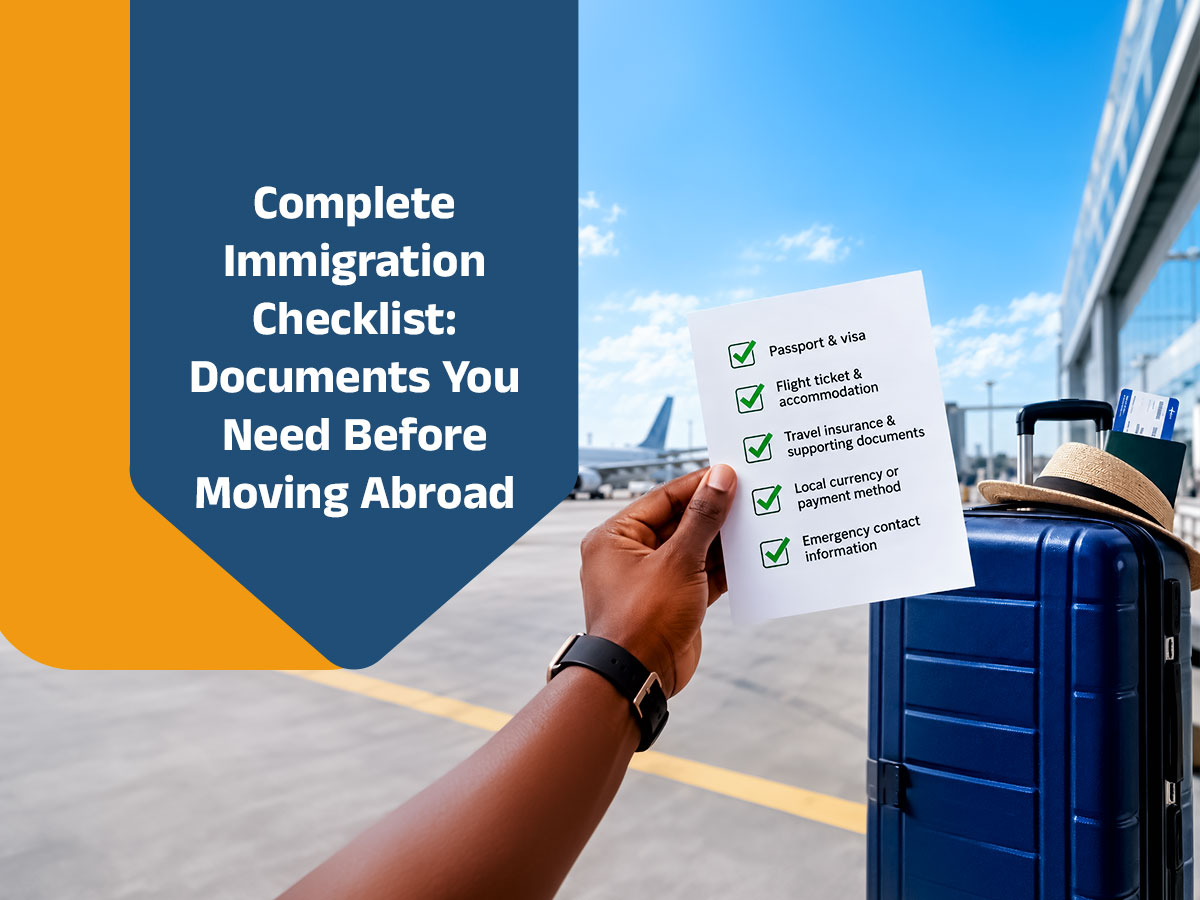
Build a Final Pre-Submission Checklist
Before submitting your immigration application, create one final folder and verify every item.
Identity
- ☐ Valid passport
- ☐ Previous passport or visa records, if required
- ☐ Birth certificate, if applicable
Education
- ☐ Degree/diploma certificates
- ☐ Transcripts/mark sheets
- ☐ Credential assessment, if required
- ☐ Professional qualifications
Employment
- ☐ Experience letters
- ☐ Employment contract
- ☐ Salary or income proof
- ☐ Professional licence, if applicable
Immigration
- ☐ Completed application forms
- ☐ Visa/permit documents
- ☐ Police clearance
- ☐ Medical examination
- ☐ Language test result
Family
- ☐ Marriage certificate
- ☐ Birth certificates
- ☐ Dependant documents
Financial
- ☐ Bank statements
- ☐ Sponsorship documents
- ☐ Income or tax documents, where required
Verification
- ☐ Certified translations
- ☐ Apostille/attestation, where required
- ☐ Certified copies, where required
- ☐ Digital backups
Frequently Asked Questions
What documents are required for immigration?
The requirements depend on your destination, visa category, nationality and personal circumstances. Common categories include identity, education, employment, financial, civil-status, police and medical documents.
Do all documents need to be attested?
No. Attestation or other legalisation requirements depend on the destination country, document type and purpose. Always verify the requirement before processing a document.
Do I need original documents?
Some applications require originals, while others accept certified copies or digital uploads. Follow the exact instructions provided by the relevant authority.
Should I keep digital copies of my documents?
Yes. Secure digital copies can be useful as backups while travelling or completing applications. However, a digital copy should not be assumed to replace an original where the authority specifically requires one.
When should I start preparing my documents?
Start as early as possible once your immigration pathway becomes clear. Some documents, assessments, certificates and verification processes can take time, so leaving everything until the application deadline can create avoidable pressure.
Final Thoughts
Moving abroad involves much more than booking a flight and securing a visa. Your documents create the paper trail that helps establish who you are, what you have studied, where you have worked, your family relationships, and whether you meet the requirements of your immigration pathway.
The smartest approach is not to collect every possible document blindly. Start with your specific destination and visa category, identify the official requirements, and then work backwards to prepare each document in the correct format.
Keep originals secure, maintain digital backups, check expiry dates, and verify whether translation, certification, apostille, or attestation is required.
Most importantly, remember that immigration requirements are not universal. Official authorities can update forms, supporting-document rules and procedures, so your final immigration documents checklist should always be checked against the current requirements for your specific application.
When your documents are prepared properly, the goal is simple: fewer surprises, fewer last-minute corrections and a much more organised move abroad.